How Car Dealers Can Use AI to Increase Sales in 2026
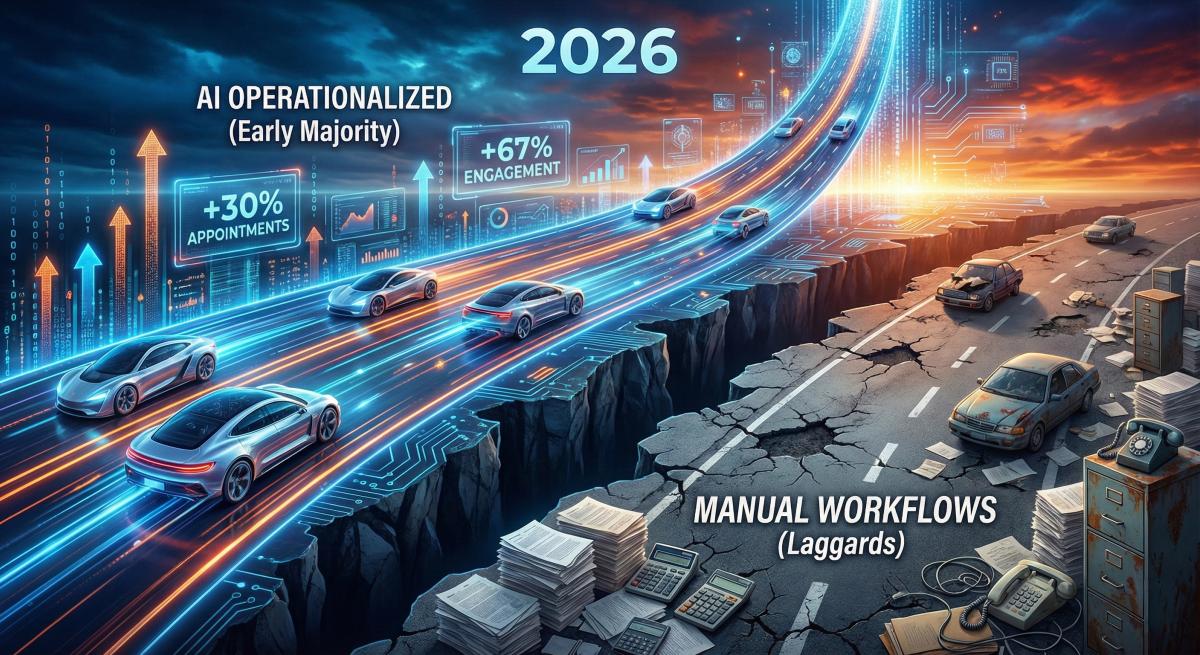
For dealerships, 2026 is not about “trying AI.” It is about operationalizing AI as the backbone of lead capture, appointment setting, inventory presentation, and margin protection. Spyne frames 2026 as the first true “AI Operations Year”, with 76% of dealers planning to increase AI budgets, and top investment priorities centered on voice AI for lead response/calls/service scheduling (74%), followed by merchandising & inspection automation (68%) and pricing & analytics (62%).
On the revenue side, Fullpath’s industry research reports that 100% of dealerships using AI saw revenue increase, and 55% reported a 10–30% revenue lift.
1) What changed in 2026: AI moved from “tool” to “infrastructure”
Dealership economics tighten when response time, follow-up discipline, and inventory execution are inconsistent. AI becomes valuable when it is embedded into workflows that directly control:
- Speed-to-lead and appointment conversion (sales leakage prevention)
- Inventory merchandising quality and consistency (online engagement and trust)
- Pricing agility with guardrails (margin + days-to-turn)
- Persistent follow-up across the “intent gap” (buyers who convert weeks later)
This is why 2026 investment is shifting to operations-first deployments rather than “nice-to-have” pilots.
2) Where to implement AI first (highest ROI order)
Priority 1: AI Voice/Chat Agents (lead response + inbound calls + scheduling)
Why it wins: It reduces the most expensive leak—paid and organic demand that never becomes a conversation or appointment. Spyne’s dealer survey lists voice AI as the #1 priority for 2026.
What “good” looks like (minimum viable):
- Responds instantly 24/7 (phone, chat, SMS)
- Qualifies intent and books appointments (not just “captures info”)
- Logs a clean summary into CRM for human follow-up
Reference implementation signal: Capital One describes “Chat Concierge” as a multi-agentic assistant that doesn’t just answer questions—it takes action, including comparing vehicles, exploring financing, trade-in estimates, and scheduling test drives while plugging into dealer systems.
A third-party writeup also reports stronger conversion performance vs. prior approaches (use as directional evidence, not as a universal benchmark).
Priority 2: Merchandising & Inspection Automation (inventory that converts)
Why it wins: Online engagement is a conversion prerequisite. Automation standardizes photos, descriptions, and listing quality—reducing time-to-market and increasing buyer confidence.
What to automate:
- Standard photo sets per vehicle (consistent angles, lighting, labeling)
- Structured descriptions (features, condition notes, disclaimers)
- “Value signals” included systematically (certification, warranty, inspection, financing options)
Spyne identifies merchandising/inspection automation as the second-highest investment area for 2026.
Priority 3: Pricing & Analytics (protect margin while improving days-to-turn)
Why it wins: Pricing errors are expensive in both directions:
- Overpriced units age and trap capital
- Underpriced units sell fast but sacrifice gross profit unnecessarily
Spyne lists pricing and analytics as a key focus area (62%).
Set pricing guardrails (minimum front gross, discount limits, brand constraints) and use AI to recommend (or automate) adjustments based on market conditions and inventory aging.
Priority 4: AI Follow-up + CRM orchestration (win the intent gap)
Most leads do not close on the first touch. AI is strongest here when it orchestrates:
- Lead scoring and routing (high intent → best reps)
- Multi-channel sequences (SMS/email/call) with behavioral triggers
- Appointment reminders that lift show rate
Fullpath’s research supports that dealers are seeing measurable revenue impact from AI adoption (distribution across revenue lift ranges).
3) The KPI dashboard a Dealer Principal should actually review
Sales KPIs (revenue control)
- Response Time (target: seconds/minutes, not hours)
- Lead-to-Appointment Rate
- Appointment Show Rate
- Close Rate by source (track “AI touched lead: yes/no”)
- Gross Profit per Vehicle (front/back split if relevant)
Operational KPIs (efficiency control)
- Contact Rate (percent of leads meaningfully contacted)
- BDC cost per appointment (if BDC exists)
- Days-to-Turn + aging buckets (15/30/45/60+)
Use Fullpath’s reported revenue lift distribution as a performance reference point, not a promise—your results will depend on execution and adoption.
4) A 90-day implementation roadmap (no chaos, measurable impact)
Days 0–30: Stop losing leads
- Deploy AI voice/chat for after-hours first, then expand to 24/7
- Define SLAs: response time, appointment rules, escalation rules
- CRM logging: lead source, intent summary, booked appointment, next action
Days 31–60: Make inventory “conversion-ready”
- Enforce listing standards (templates + required fields)
- Track VDP engagement per unit and fix bottom performers
- Standardize disclaimers and condition notes (reduce buyer friction)
Days 61–90: Defend margin and improve days-to-turn
- Implement pricing guardrails + aging playbook
- Weekly review: pricing actions taken, outcomes, and exceptions
- Tie pricing decisions back to gross and turn-rate (not vanity “clicks”)
This aligns with Spyne’s “operations year” thesis and dealer investment priorities.
5) Risks and how to mitigate (without slowing down)
Risk 1: AI responses that damage trust
Mitigation: controlled scripts + strict boundaries (what AI can promise, what requires human confirmation) + QA sampling.
Risk 2: Dirty CRM data
Mitigation: minimum viable cleanup: lead source, timestamps, inventory mapping, disposition codes. “Garbage in” will degrade both AI and reporting.
Risk 3: Staff resistance
Mitigation: position AI as the system that increases commissions by increasing qualified appointments and reducing busywork. Fullpath’s survey-based reporting indicates broad confidence that AI boosts revenue among adopters—use that as internal change-management proof.
Preguntas Frecuentes
What is the best first AI use case for car dealerships in 2026?
Start with AI voice or chat agents for 24/7 lead response and appointment scheduling. Dealer research cited by Spyne places voice AI as the top investment priority for 2026.
Does AI actually increase dealership revenue, or just reduce labor?
Industry reporting from Fullpath indicates all surveyed AI-adopting dealerships reported revenue increases, with a large share reporting 10–30% revenue lift. Results vary by execution quality and adoption.
How long does it take to see results after implementing AI?
You should see early movement in response time, contact rate, and appointment rate in the first 30 days (if integrated correctly). Broader margin and inventory-turn improvements typically require 60–90 days of disciplined ops changes.
What KPIs should dealers track to measure AI ROI?
At minimum: response time, lead-to-appointment, show rate, close rate (AI-touched vs. not), gross profit per vehicle, and days-to-turn with aging buckets.
What is “Chat Concierge” and how does it help dealers?
Capital One describes Chat Concierge as a multi-agentic assistant that can compare vehicles, discuss financing, estimate trade-in value, and schedule test drives while integrating into dealer systems.